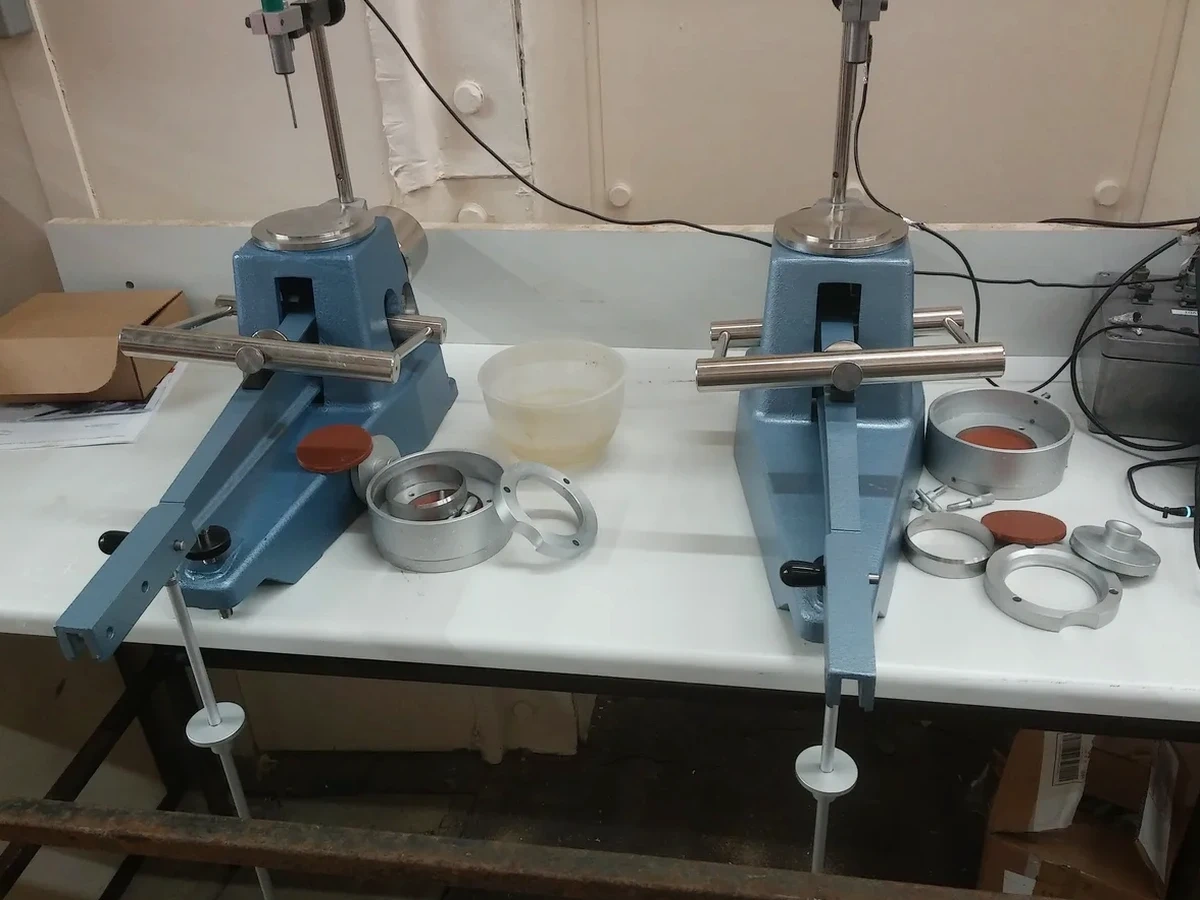
In Hartford, the Connecticut River Valley's post-glacial geology often deposits layers of fine-grained sediment that behave quite differently from the granular tills found in the surrounding uplands. A visual classification simply won't cut it when you're placing footings in the North End or designing an embankment near the Park River conduit. These lacustrine silts and clays can change volume dramatically with moisture fluctuation, and their engineering behavior hinges on the relationship between water content and consistency. That's where Atterberg limits testing comes in: a set of index tests that quantify the liquid limit, plastic limit, and plasticity index, giving the design team a reliable framework for predicting how the soil will perform under load and seasonal wetting cycles. When we run these tests on samples from a test pits investigation in the South Meadows, we're often surprised by how much the plasticity index varies within a single borehole. Complementing that with grain size analysis lets us fully classify the material per ASTM D2487, which the Connecticut Department of Transportation requires for all earthwork specifications.
The plasticity index of Hartford's Connecticut River Valley silts often falls between 8 and 25, indicating moderate compressibility and a susceptibility to frost action that directly impacts pavement design.
Site-specific factors
Skipping Atterberg limits testing on a Hartford site underlain by fine-grained alluvium introduces a risk that manifests slowly and expensively. Consider a slab-on-grade warehouse in the South Windsor Avenue industrial corridor: if the subgrade is a lean clay with a plasticity index of 18 and the moisture content isn't controlled during compaction, the slab will curl and crack as the soil dries and shrinks during the first heating season. The liquid and plastic limits define the moisture range where the soil remains stable, and operating outside that window—either too wet during placement or too dry during service—invites differential movement. We've also seen retaining walls along the Park River experience progressive tilting because the backfill's plasticity wasn't assessed, and the material crept under sustained loading. The standard of care in Connecticut, reinforced by the Connecticut State Building Code and IBC Chapter 18, expects that all cohesive soils be classified by Atterberg limits for any structure where settlement or lateral earth pressure is a design consideration.
Reference standards
ASTM D4318 – Standard Test Methods for Liquid Limit, Plastic Limit, and Plasticity Index of Soils, ASTM D2487 – Standard Practice for Classification of Soils for Engineering Purposes (Unified Soil Classification System), IBC Chapter 18 – Soils and Foundations (referenced by Connecticut State Building Code), ASCE 7 – Minimum Design Loads and Associated Criteria for Buildings and Other Structures
Quick answers
What do Atterberg limits actually tell me about my Hartford site?
The liquid limit and plastic limit define the moisture content boundaries between solid, semisolid, plastic, and liquid states of a fine-grained soil. The plasticity index (LL minus PL) indicates how much water the soil can absorb while remaining plastic, which correlates with compressibility, swell potential, and shear strength. For Hartford's varved clays, a PI above 20 often signals a soil that will require moisture conditioning during compaction and may be susceptible to frost heave.
How much does Atterberg limits testing cost per sample?
Standard Atterberg limits testing (liquid limit and plastic limit per ASTM D4318) typically ranges from US$60 to US$100 per sample, depending on whether a one-point or multipoint liquid limit is requested and if the plastic limit is included. Expedited turnaround may carry a slight surcharge.
How long does it take to get Atterberg limits results?
Standard turnaround is 3 to 5 business days from sample receipt. The procedure requires oven-drying a representative portion of the sample, sieving through the No. 40 sieve, and then performing the Casagrande cup test and rolling thread procedure. Rush processing can deliver results in 24 to 48 hours for active construction projects in the Hartford area.
Can you run Atterberg limits on samples with visible organic content?
Yes. For soils from Hartford's floodplain that contain organic fibers or a dark color suggestive of organic matter, we follow the wet preparation method outlined in ASTM D4318 to minimize oxidation of the organics during drying. We recommend pairing Atterberg limits with an organic content determination (loss on ignition) for a complete assessment, especially on sites near the Connecticut River oxbows.