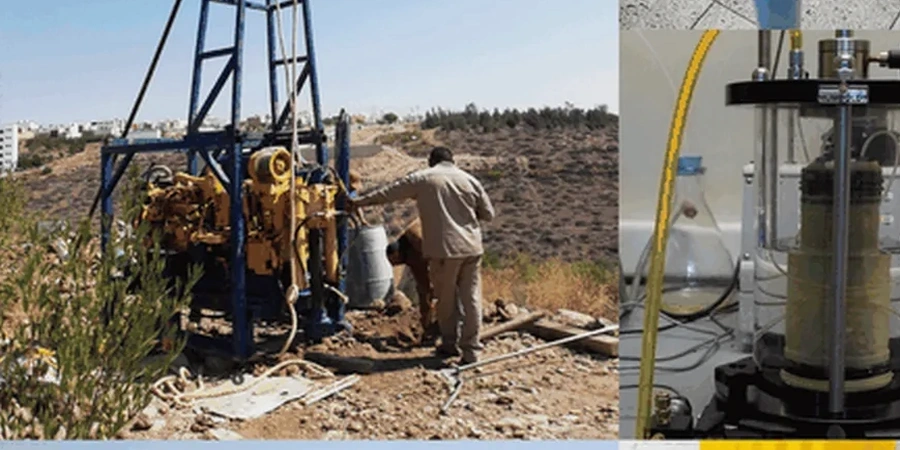
Hartford sits at roughly 60 feet above sea level on the floodplain of the Connecticut River, where centuries of sediment deposition have created complex subsurface conditions. The city’s 125,000 residents rely on infrastructure built atop varved clays, glacial till, and occasional peat lenses left by Glacial Lake Hitchcock. A soil mechanics study here must account for these layered deposits, which can shift dramatically within a single block. The 1936 flood proved how quickly saturated silts lose bearing capacity downtown. Our lab processes Shelby tubes and SPT samples from Hartford projects daily, running triaxial compression on the brownstone-derived residual soils that underpin the Asylum Hill neighborhood. When contractors hit organic silt at 15 feet near the Bulkeley Bridge approach, the CPT test provides continuous tip resistance and sleeve friction data to map the weak zone before designing deep foundations. The team applies ASTM D1586 procedures for all standard penetration testing and classifies every sample under ASTM D2487, ensuring the soil mechanics study meets IBC Chapter 18 requirements for seismic site class determination.
Hartford’s varved clay exhibits a coefficient of consolidation (cv) that can differ by an order of magnitude between vertical and horizontal drainage paths.
Site-specific factors
The biggest challenge in Hartford is differential settlement where footings transition from dense glacial till to the softer varved clay deposits—a condition common along the Park River conduit and the western edge of downtown. A soil mechanics study that misses a peat pocket or an abandoned mill race can underestimate total settlement by 2 inches or more, cracking brick facades within five years. The second risk is seismic site amplification. The deep soil column over bedrock, which sits 100 to 200 feet below the surface, amplifies long-period motion during distant earthquakes. A site classified as E by mistake triggers unnecessary deep foundation costs. Conversely, calling it D without proper shear wave velocity data from the soil mechanics study leaves the structure underdesigned for the 2,475-year return period ground motion. We see this tension in every project near the historic district, where preservation requirements add another layer of consequence to a wrong assumption about the subsurface profile.
Reference standards
ASCE 7-22 (Minimum Design Loads and Associated Criteria for Buildings and Other Structures), IBC 2024 Chapter 18 (Soils and Foundations), ASTM D1586 / AASHTO T 206 (Standard Penetration Test), ASTM D2487 (Unified Soil Classification System), ASTM D2435 (One-Dimensional Consolidation Properties of Soils), ASTM D4767 (Consolidated Undrained Triaxial Compression Test)
Quick answers
How much does a soil mechanics study cost for a typical commercial lot in Hartford?
For a standard commercial lot in Hartford, a soil mechanics study that includes SPT drilling, laboratory index testing, consolidation, and triaxial shear typically ranges from US$3,250 to US$4,580. The final figure depends on boring depth, number of samples, and whether specialized tests like resonant column for seismic site response are required. Projects in the floodplain with deeper borings or more consolidation frames will land at the upper end.
What laboratory tests are mandatory for foundation design in Hartford’s varved clay?
At minimum, we run Atterberg limits, natural moisture content, and pocket penetrometer readings on every Shelby tube. One-dimensional consolidation is mandatory because settlement, not bearing capacity, usually controls footing size in the clay. Undrained triaxial compression provides Su for short-term stability. If the project falls under ASCE 7 seismic provisions, shear wave velocity measurement or correlation to SPT N-values determines the site class.
How long does the laboratory phase of a soil mechanics study take for a Hartford project?
Standard index testing and classification wrap up in 5 to 7 business days after samples arrive at the lab. Consolidation tests run longer because each load increment requires 24 hours for primary consolidation to complete; a full consolidation curve takes 7 to 10 days. Triaxial shear adds another 5 days. Expect 3 to 4 weeks for a complete geotechnical report with all lab data interpreted and foundation recommendations drafted.